Showing posts with label Strategy. Show all posts

Monday, October 1, 2007

Balanced Score Card-An Integrated Management Approach

Hi friends
Very often in every business, whether its SME or MNC the management gets into dilemma what measures to focus at. Is it financials or is it marketing? Then managers especially the top ones, are always in constant hurry to get over with all the report studies. I worked in medium sized company as well as world renowned MNC’s like Philips and GE but it was all same. Higher you move, more load of reports get on you. But, the question is, is it worth that effort? Why can’t be simpler and leaner reporting system? Even lean operations experts find themselves juggling with this scenario. The answer to these problems lies in Balanced Score Card Approach.

What is so special about it?
The name itself suggests, it creates balance. It focuses on four prime perspectives, i.e.
· Financial Perspective-How do we look to our shareholders?
· Customer Perspective-How do customers see us?
· Innovation and learning Perspective- Can we continue to improve and create value?
· Internal Business Perspective-What must we excel at?

The reason is quite simple; all the above perspectives together make the heart of the company. But, at the same time, some are leading indicators while others are lagging indicators. The company can’t have strong financials in the long term, if we are loosing our customer perspective. Also, we will get beaten overnight by some e-commerce company, if we don’t focus on Innovation and Learning perspective. Also, its very important to choose which core competency to develop before you are having sleepless nights, due to impending strategic inflection point.

So, balance card is a tool that creates a balance between all the mentioned four perspectives as well as between long term and short term perspective. Its very easy at times, to have good customer excellence, and screwing your financials, and vice versa. But, business can run only if there is balance.

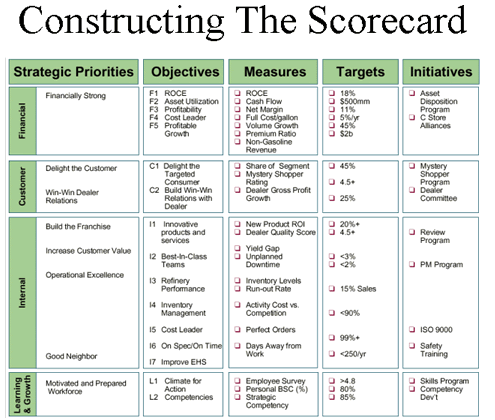
So, balance card gives us a strategic tool, in which we create metrics which will govern the key perspectives. The metrics can vary from company to company.
The typical metrics are:

Financial Metrics
· ROI
· Growth rate of profit
· EPS

Marketing Perspectives
· Growth rate in sales revenue
· Growth rate of customer base
· Customer Satisfaction rating
· Growth in market share
Internal Business Processes Perspective
· Manufacturing excellence
· Sales Excellence
· Logistics Excellence

Growth and Learning Perspective
· Reduction in New Product Introduction cycle
· Reduction in throughput time
· Reduction in cycle time

Now these metrics act as MIS for top management. And its drilled down at every department and every level to align the actions of everyone in the organization to the objectives of the business.

Further these metrics are supported by the measures, targets, and initiatives in front of each metric. And finally, these metrics enable the whole business activity.

Tuesday, September 25, 2007

Google & Strategy

Hello friends
We i.e. Prabal, Virinder Singh Villkhoo, Abhishesh Sharma, recently did assignment on Strategic Analysis of Google Inc. Few of the normal strategy elments have been posted here, with analysis of Google. I hope you will enjoy it.
We give special thanks to www.arbitmba.com for providing with comic strip above.


World's Search Market


Dynamic View of Google's Strategy


Monday, September 3, 2007

Friday, August 17, 2007

Mckinsey's Seven S's Model

Time of Concept: 1980
Use for : Consulting, Decision making, Organizational effectiveness, strategy formulation
Seven ‘S’s

Strategy : In-tune with Vision and mission of organization
Structure : Amalgamation of corporate hierarchy and external environment
System : The Standard Operating Procedure for work, methodology
Staff : The different personnel in various departments of the organization
Style :The learning curve level of the managers
Skills : The core-competencies of the organization
Shared Value : The culture, core beliefs, foundation of the organization
Pros:
Easy to apply, combines all the rational elements with emotional elements, developing the experience curve
Cons:
The focus should be on all S parallel, Most of the company following this vanished in 1990s

Reviewed by: Abhishesh Kumar Sharma

Monday, August 13, 2007

Porter's Diamond


A diagram showing four conditions:


-->Demand conditions


-->Factor Endowments


-->Related and Supported industries


-->Firm strategy, structure, and rivalry


that usually must be all favorable for an industry in a country to develop and sustain global competitive advantage.

1. Demand Conditions: Market demand of a product in local market and foreign market.If the demand is more in the local market the company must focus on that product to develop a sustainable competitive advantage
2. Factor Conditions: A company has both natural and acquired resources.It can create its own factors like skilled labor,strong technological base,etc in order to develop its core competencies
3. Related and Supported Industries : If the local related industris are competitive it will force the company to innovate and be competitive and rapidly respond to changes in the external environment.
4. Firm's Strategy,Structure and Rivalry :
The culture of a country have an effect on the firm's strategy and structure.For instance certain countries have more family owned businesses than others which are more hierarchial.
Rivalry might help a company from being competitive.It helps a company to continuously compete with the others and continuously improve their value chain and thrive for innovation in products and processes.

Thursday, August 9, 2007

A Management Strategy

A Management Strategy
I witnessed some interesting behaviour from one of our premier management schools this summer. A behaviour that I have since discovered is not uncommon.

This summer I met the PA of an emminent professor at a business school.
I had met her on several occassions before and knew her to be a bright chatty woman who always enjoyed passing the time of day.

On this occassion when I asked her how her week was going she looked at me and I could see that she wanted to smile but the muscles in her face would not work and after a few twitches she gave up trying and looked back at the ground.

I asked her what was the matter and she told me that her department was undergoing change.
I asked her what that actually meant.
She told me that a "Change Manager" had appeared in the department and everybody was waiting to see who got the sack.

This was a woman, who is normally a capable and confident administrator, had been reduced to a nervous wreck because she perceived that an anonymous arbiter had been brought in to decide her future.
This was her reaction to the presence of a "Change Manager" based on her perception that change meant people being sacked.

How close was this perception to reality?

I met my PA again a month later and the way that she and her colleagues had been treated made me spit.
She had got over her first shock and was now extremely angry with the college authorities.
30 senior PA's were now involved.

It seems that the chancellor and his senior team had announced the changes then brought in a consultant to ratify them.
The situation for the PA's was that they had been told that their fates would be announced in six weeks.
They had no idea how many jobs would be left after six weeks but were told that nobody would be made redundant, alternative employment would be found.

The perception of the PA's was that their managers had already decided how many would be let go and were only spinning it out under the guise of "Managed Change" because they wanted to pretend that the decision was part of a reasoned process and not the arbitrary wielding of a financial axe by the accountant.

It was awful to watch the diabolical way a centre for excellence was treating its own staff, and still had the temerity to continue to hold itself up as an example to whom we should look for learned guidance.

"What thickness is the ivory on their tower that prevents them seeing the consequences of their actions?"

My initial question was whether this girls perception of change was shared by others.
It seems that it is.
I spoke to my PA friend again last month and they were still telling her to wait while the decision was made about her future.
She could not endure the stress any longer and started to look for alternative employment.
As she said, she loved the job that she used to have,

The authorities had through their actions caused her to lose trust in them and come to hate the job that was now causing her so much stress.
She could not consider continuing to work for them even if they announced tomorrow that her job was safe because she could not continue to work for, or trust, people who had caused her so much pain.

This behaviour from a respected university that is held up as a centre of management excellence is, in its personal effect on these individuals, appalling.

It is interesting to note that the bosses of all the PA's affected had by this time been asked to reapply for their jobs too.
The PA that I know told me that her boss has started to look for work elsewhere for the same reasons as she had.

Last week I met the PA again and she told me that both she and her boss had found new jobs, still working together, at a neighbouring school.
It does not have the same reputation but that is a situation that neither of them thinks will last for very long.

Having spent long hours discussing how diabolical the action of the college was the PA's had come to realise that what was apparently just another example of Crass bad management was in actual fact management best practice.
As a centre of management excellence one of the techniques that was advocated to avoid making redundancy payments when you need to get rid of people is too make the workplace so stressful that they choose to leave.

The favourite technique for doing this is to make people reapply for their own jobs.

I am happy to report in this instance that the management school were well and truly stuffed.

My PA, and a number of others who had all found alternative employment, accidentally neglected to tell the college that they had found alternative employment.

The result was that the college, when nobody left voluntarily, were forced to announce the redundancies. Every single person made redundant took their payment then walked straight into a new job that they had already accepted.

The college still had to make redundancy payments to the people it had always intended laying off but in addition it also had the expense of recruiting new staff to fill all the other posts of the people who had left because of the shoddy way the college had treated their staff.

What goes around, comes around.

Score one for the good guys.

Peter A HunterAuthor of "Breaking the Mould"http://www.breakingthemould.co.uk/

Monday, July 23, 2007

INFLECTION POINT


Inflection Point of a Company

“An inflection point occurs where the old strategic picture dissolves and gives way for the new.”

A strategic inflection point is a time in the life of a business when its fundamentals are about to change. That change can mean an opportunity to rise to new heights. But it may just as likely signal the beginning of the end. Understanding inflection point can help leaders, decision makers and voters to detect a change in outlook for better decision making process.


What is The Real World Strategic Inflection Point?
Finding the real world social, political, historical, business, individual strategic inflection point is far more difficult to detect than Mathematical inflection points, requires knowledge and high level of awareness.
Real world inflection point occurs where the old strategic picture dissolves and gives way to the new situation, allowing the social, political, historical, business, individual to ascend to new heights. However, if you don't detect and navigate our way through a peak and after the peak then the declines and disaster will occur. It is around such inflection points that things are different puzzled and hard to observe. Something major has changed and new direction, idea is needed to ascend not descend.
There are, basically, two types of inflection points. Any company needs to take care of both for sustaining its path of progress. The two are:
The start-up inflection point.
Lateral inflection point.
For a Start-up inflection point, the basic premise is:
Small engineering start-up is born, does well, hires like mad.
Heavy hiring bias for self-driven solo programmer prodigies.
Company grows; scores of engineers running around.
Soon primary challenge isn’t quality programmers: it’s organizing them.
No matter how self-directed programmers are, eventually their utility declines as ambiguities in direction, roles, goals and ownership become increasingly distracting and frustrating. The company is changing because of scale effects - but scale effects are hard to recognize, predict or compensate for. Hiring more brilliant engineers won’t solve this problem. So the companies come to the verge of what we call a Start-up Inflection Point.
The other type of inflection point that comes at a lateral stage in the life cycle of a company and that keeps on coming from time to time is Lateral Inflection Point. It comes whenever there comes a change in the external environment of the company. This usually brings with it a fundamental change in the way the business needs to be managed and usually hard to foresee. This may rejuvenate or may destroy a company, depending upon the actions taken in response. But the managerial capability lies in judging these changes in advance and taking proactive measures to manipulate them in company’s favour.

Wednesday, June 6, 2007

Strategy as Defined by Michael Porter

Earlier, it was believed that operational effectiveness is the best way to develop a strategy for the business. It is the only way to survive in the competitive world. It was believed that creating a positioning in the market will actually hamper the competitive growth and adaptation to the modern techniques. It will very soon be outdated and then we will be out of the market. It is only about the best practices adopted by the company that makes the world leader.
Michael Porter had a different view in this regard which proved to be more appropriate in the present context. Here are some of the excerpts of his ideas:
v Operational effectiveness is a necessary but not a sufficient measure to sustain in the market. Through best practices, we can definitely create a mark but on account of high technological developments, all the companies will sooner or later achieve the same. Hence our value proposition will not be sustainable.
v Different set of activities carried out by the companies helps it achieve a distinct positioning in the market which is quite important for a company to sustain world leadership.
v Our strategy must be to chose an entirely different set of activities than that of our rivals according to our company’s strengths and develop a strategic positioning in the market keeping a greater horizon in mind and not a single planning cycle.
v Strategic positioning is of three types:
1. Access based positioning-locality
2. Need based positioning- value for money
3. Variety based positioning-offerings
v Tradeoffs are a very important part of making a strategy. A company cannot go for more than one position. One cannot provide cost cutting and premium quality at the same time. The company which wants to have all the things at the same time ultimately fails due to fallacy of implementation in the whole process. Hence tradeoffs are quite necessary for any company.
v Fit must be developed among various activities to make then inimitable for the rival companies. It gives the companies a sustainable competitive advantage over the competitors.
v There are three degrees of fit:
1. First order fit allows various activities to be interlinked.
2. Second order fit has all the activities reinforcing each other to create an inimitable set of activities.
3. Third order fit has an optimization of efforts i.e. how all the activities have been interlinked to give the most optimized set where we can have the maximum output.

v Hence a company management has to perform three core activities:
1. defining strategic positioning
2. making tradeoffs
3. forging fit among various activities
To advertise on our blog write in to us at aggarwal.prabal@gmail.com

Disclaimer

All the content, information and comments presented on the Management Informatika blog at http://www.managementinformatika.blogspot.com are those of the authors of posts and comments and not of the blog Management Informatika.